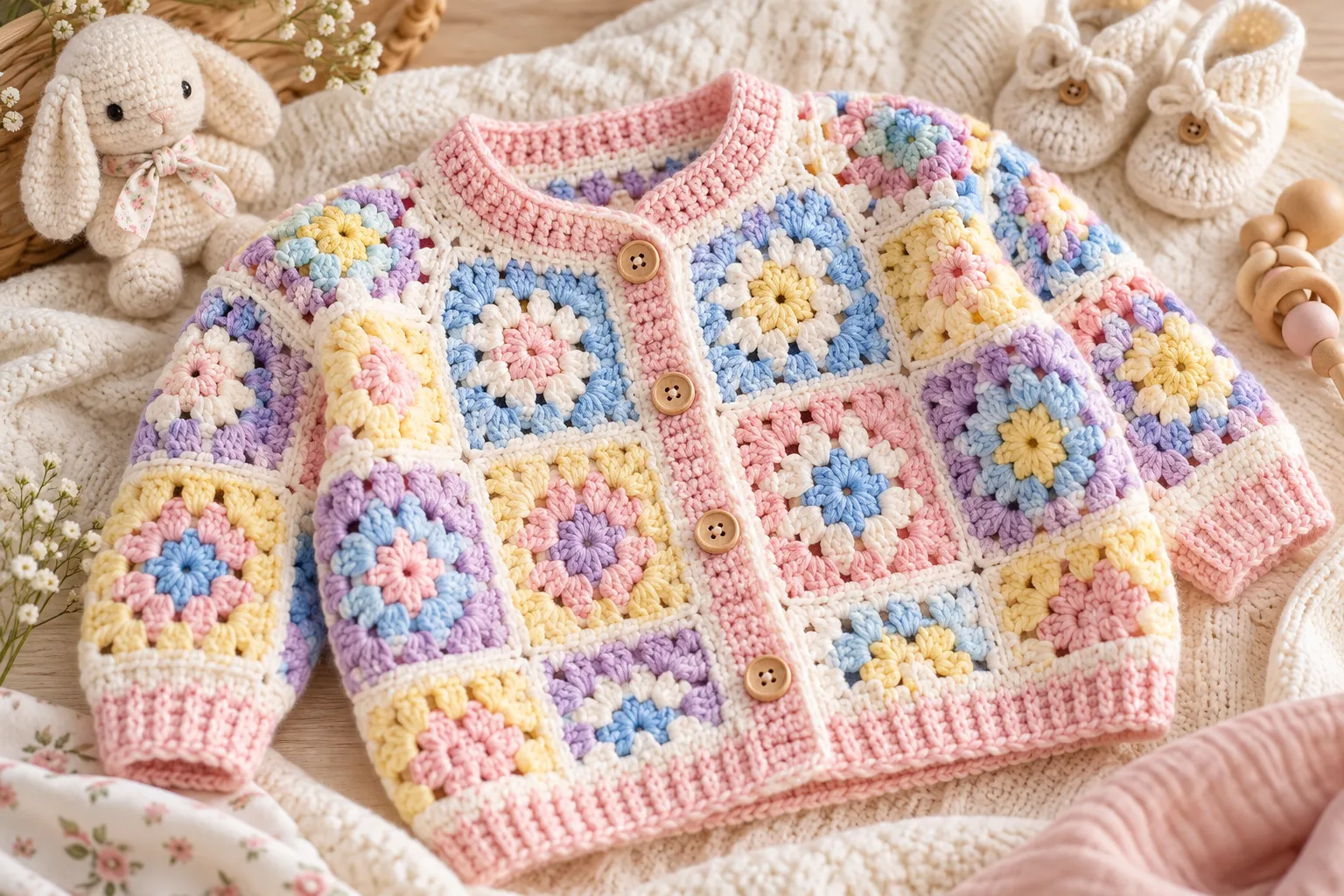
A handmade baby cardigan is one of those crochet projects that feels special from the very first stitch. This crochet baby vest pattern combines classic granny-square construction with a simple cardigan silhouette, creating a sweet handmade layer that works beautifully for newborns, babies, and toddlers.
The design is especially appealing if you love projects that look detailed without requiring complicated stitch techniques. Traditional granny squares bring color and texture, while the cardigan construction keeps the finished piece practical and comfortable for little ones.
In this guide, you’ll learn how to plan and crochet a granny square baby cardigan, choose yarn and colors, understand the construction, adjust the size, add finishing details, and customize the vest for different seasons and styles.
Why Crochet a Granny Square Baby Cardigan?
Granny squares are ideal for baby garments because they are versatile, customizable, and relatively easy to construct.
Instead of crocheting an entire garment from one long sequence of rows, you can create individual squares and join them together. This makes the project easier to manage and allows you to experiment with colors.
A granny-square cardigan also makes a wonderful:
- Baby shower gift
- Newborn photo-session outfit
- Handmade birthday gift
- Layering piece for cool weather
- Keepsake garment
- Scrap-yarn crochet project
The classic granny-square appearance gives the cardigan a nostalgic handmade quality while modern color combinations can make it look fresh and contemporary.
Materials You’ll Need
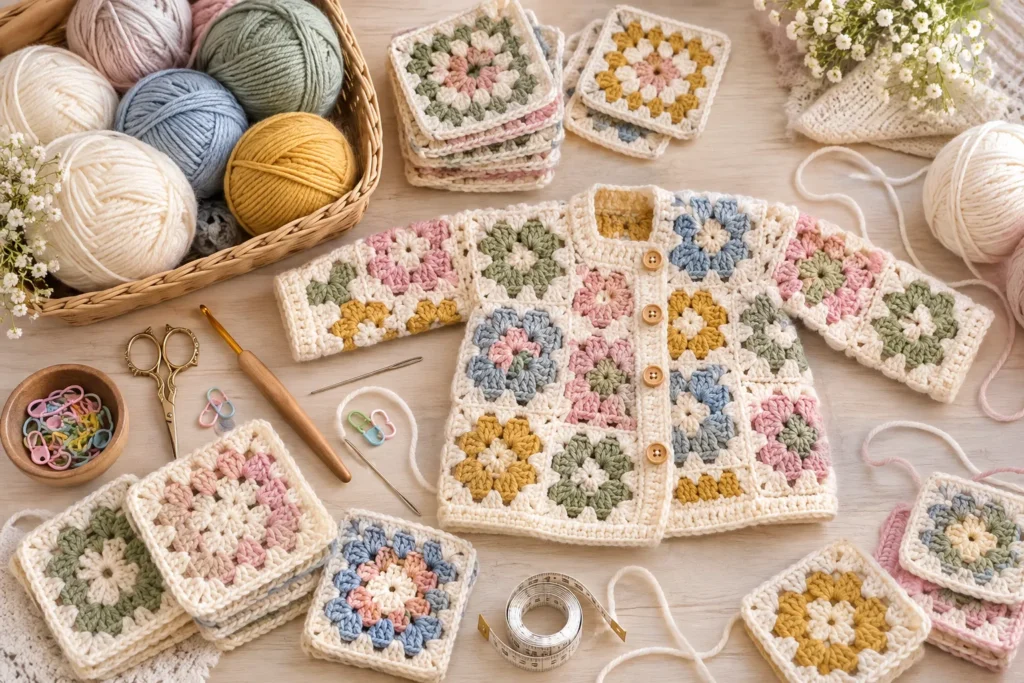
Before beginning, gather the following supplies:
| Material | Recommendation |
|---|---|
| Baby yarn | Soft DK or light worsted yarn |
| Crochet hook | Choose according to yarn label and desired fabric |
| Tapestry needle | For weaving in ends |
| Scissors | Sharp yarn scissors |
| Stitch markers | Helpful during construction |
| Measuring tape | Essential for checking size |
| Buttons | Optional |
| Blocking mats | Recommended for granny squares |
Choosing Baby-Friendly Yarn
For a baby cardigan, softness should be one of your main priorities.
Look for yarn that is:
- Soft against delicate skin
- Washable
- Lightweight
- Comfortable for layering
- Durable enough for repeated washing
Acrylic designed for baby garments is practical because it is usually easy to wash and maintain. Cotton can also work well, especially for warmer weather, although it tends to create a different drape.
Avoid yarn that feels scratchy or overly textured.
Choosing Your Color Palette
One of the most enjoyable parts of making a granny-square cardigan is selecting the colors.
You can create a traditional multicolor cardigan or use a restrained palette for a more modern look.
Soft Pastels
Try combinations such as:
- Cream
- Blush pink
- Baby blue
- Soft lavender
- Pale yellow
This palette creates a delicate nursery-inspired aesthetic.
Neutral Baby Cardigan
For a timeless cardigan, combine:
- Cream
- Oatmeal
- Beige
- Taupe
- Soft brown
Neutral colors make the cardigan particularly versatile.
Rainbow Granny Squares
For something playful, use several cheerful colors with a neutral joining color.
For example:
- Pink
- Yellow
- Blue
- Green
- Lavender
- Cream
Keeping the border consistent helps the different colors look coordinated.
Granny Square Construction
The basic granny square is made by working groups of stitches into the spaces between previous rounds.
A traditional structure generally consists of:
- A center ring
- Groups of double crochet stitches
- Chain spaces
- Four corners
- Additional rounds to increase the square
The square becomes larger with every round.
For a baby cardigan, the exact number of rounds and squares depends on the desired size and the dimensions of your particular yarn and tension.
Basic Granny Square Instructions
This is a simple traditional granny-square framework that you can adapt to your project.
Round 1
Begin with a magic ring or chain stitches joined into a ring.
Work groups of double crochet stitches separated by chain spaces around the center.
Close the round and join.
Round 2
Move into a corner space and work another group of double crochet stitches.
Continue around the square, placing additional groups into the corners and spaces.
Following Rounds
Continue working groups of double crochet stitches into the spaces between groups from the previous round.
At each corner, create a larger chain space so the square can continue expanding.
Continue until your square reaches the measurements needed for your cardigan construction.
How the Baby Cardigan Is Constructed
The cardigan can be built by arranging granny squares into a simple garment shape.
A basic construction can include:
- Back panel
- Two front panels
- Shoulder area
- Side seams
- Armholes
- Front edging
- Optional sleeves
- Optional button closure
The granny squares create the visual pattern, while additional crochet edging helps unify the finished garment.
One advantage of this construction is that you can make adjustments before joining everything permanently.
Measuring for the Correct Size
Baby clothing sizes can vary significantly between children, so measurements are more reliable than relying exclusively on age labels.
Important measurements include:
Chest circumference: Measure around the fullest part of the chest.
Cardigan length: Measure from the shoulder down to the desired hem.
Shoulder width: Measure across the shoulders.
Armhole depth: Measure from the shoulder toward the underarm.
Sleeve length: If adding sleeves, measure from the shoulder or underarm to the desired sleeve length.
For a cardigan intended as an outer layer, a small amount of positive ease can make it more comfortable.
Granny Square Baby Cardigan Size Guide
Use the following as a planning reference rather than an exact sizing rule.
| Approximate Size | Typical Use | Important Consideration |
|---|---|---|
| Newborn | Very small baby | Keep fabric lightweight |
| 0–3 months | Early infancy | Allow comfortable movement |
| 3–6 months | Infant | Add a little growing room |
| 6–12 months | Older baby | Consider sleeve length |
| 12–18 months | Toddler | Increase body dimensions |
| 18–24 months | Toddler | Check chest and length carefully |
Because crochet tension varies, always compare your work with the child’s measurements whenever possible.
Joining the Granny Squares
Once your squares are complete, you need to connect them.
There are several ways to join granny squares.
Slip-Stitch Join
A slip-stitch join is simple and creates a visible seam.
It works particularly well when you want the joining lines to become part of the design.
Whip Stitch
A tapestry needle and yarn can be used to sew the squares together.
This method provides a flexible connection and can be particularly useful when you want the seams to remain subtle.
Single Crochet Join
You can also crochet the squares together using single crochet.
This creates a raised seam and can introduce an attractive contrasting detail.
Flat Join
A flat crochet join creates a relatively smooth connection between squares.
It is a good choice when you want a cleaner, more polished appearance.
Creating the Cardigan Shape
Lay your completed squares flat before joining them.
This is an important step because it allows you to check:
- Color placement
- Symmetry
- Overall dimensions
- Front and back proportions
- Armhole placement
Take a photograph of your arrangement before joining if you are working with multiple color combinations. This gives you a useful reference if the pieces become mixed up.
Shaping the Front
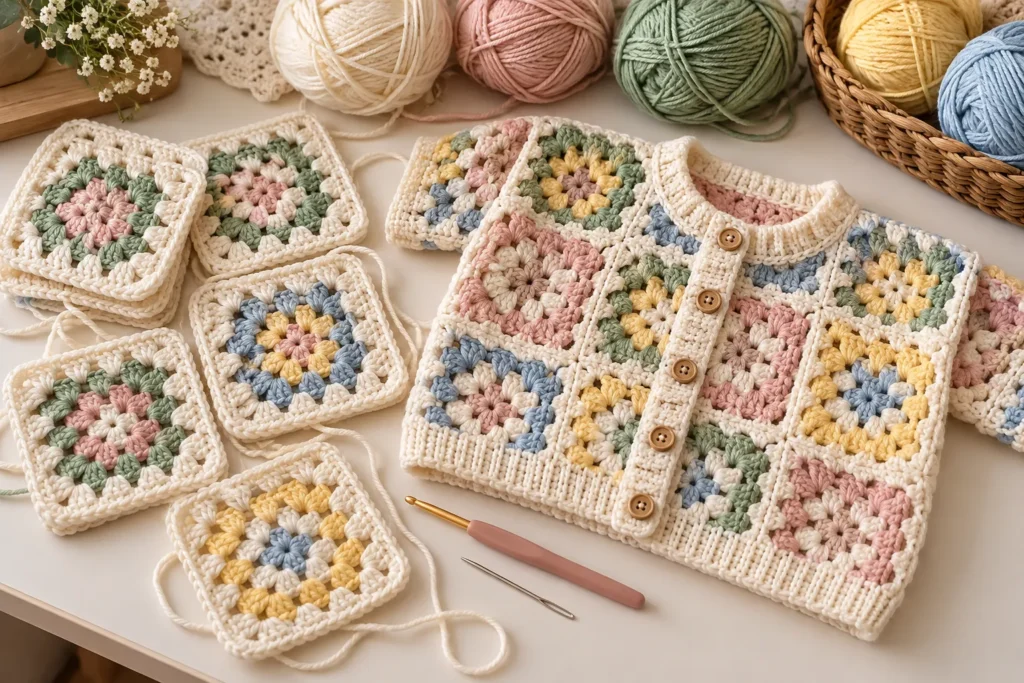
For an open cardigan, the front can remain completely open.
If you want more coverage, create two front panels with a small gap between them.
The opening can be finished with a contrasting border.
You can also add:
- Buttons
- Wooden toggles
- Crochet ties
- A small loop-and-button closure
For babies, make sure any decorative components are securely attached and appropriate for the child’s age.
Adding a Crochet Border
A border gives the cardigan a finished appearance and helps stabilize the edges.
A simple single-crochet border is an excellent option for beginners.
Work evenly around:
- Front opening
- Neckline
- Bottom hem
- Sleeve openings
For a decorative finish, you could use a shell stitch, picot edging, or a simple scalloped border.
Adding Sleeves
The cardigan can remain sleeveless for a lightweight vest-style garment, or sleeves can be added for cooler weather.
Short Sleeves
Short sleeves are ideal for spring and summer.
They can be finished with a simple single-crochet border.
Long Sleeves
For a warmer cardigan, work sleeves from the armhole downward.
A slightly tapered sleeve can create a more comfortable fit around the wrist.
Bell or Flared Sleeves
For a decorative modern cardigan, gradually increase toward the cuff to create a subtle flare.
Making a Sleeveless Baby Vest
If you prefer the vest version, simply finish the armholes with a neat crochet border.
This creates a lightweight garment that works beautifully over:
- Baby dresses
- Long-sleeve bodysuits
- T-shirts
- Rompers
- Button-up shirts
A sleeveless granny-square vest is especially useful during transitional weather.
Adding Buttons
Buttons can turn an open cardigan into a more secure garment.
Place them along one front edge and create corresponding crochet loops on the opposite side.
When making baby clothing, make sure buttons and other small components are attached extremely securely. For very young babies, always consider whether removable small parts are appropriate.
Blocking the Granny Squares
Blocking can dramatically improve the appearance of granny squares.
Before joining, gently shape each square so the corners are defined and the dimensions are consistent.
Blocking can help:
- Straighten uneven edges
- Improve square proportions
- Make joining easier
- Create a more professional finish
Always follow the care requirements of your particular yarn when choosing wet or steam blocking.
How to Avoid Uneven Granny Squares
If your squares aren’t the same size, check your tension.
Common causes include:
- Changing crochet hooks
- Working stitches too tightly
- Working stitches too loosely
- Inconsistent yarn tension
- Accidentally skipping stitches
- Different yarn thicknesses
Try to maintain a consistent rhythm while crocheting.
If necessary, use the same hook throughout the project and periodically measure your squares.
Easy Ways to Customize the Cardigan
The basic design can be changed in many ways.
Change the Colors
A single color can create a minimalist cardigan, while multiple colors create a classic granny-square aesthetic.
Change the Border
Use a contrasting color around the neckline, hem, and front opening for definition.
Add Embroidery
Small embroidered flowers, hearts, stars, or initials can personalize the cardigan.
Add Pockets
Small granny-square or crocheted pockets can turn the cardigan into a playful everyday garment.
Change the Length
Add additional rows or squares to create a cropped vest or longer cardigan.
Beautiful Color Combinations
If you’re unsure which colors to choose, try one of these palettes.
Vintage Girl
Cream + dusty pink + sage + lavender
Classic Boy
Cream + sky blue + navy + soft gray
Modern Neutral
Oatmeal + beige + mocha + cream
Autumn Baby
Rust + mustard + cream + olive
Woodland
Forest green + brown + cream + muted orange
Rainbow
Cream + pink + yellow + blue + green + lavender
Tips for Making a Baby Cardigan as a Gift
A handmade cardigan makes an especially meaningful baby shower present.
Before starting, try to find out the baby’s approximate size and the parents’ preferences.
Consider making the garment slightly larger rather than extremely fitted so the baby can enjoy it for longer.
A matching handmade accessory can also make the gift feel complete.
Ideas include:
- Crochet bonnet
- Baby booties
- Matching blanket
- Headband
- Small lovey
- Crochet mittens
Caring for a Crochet Baby Cardigan
Baby clothing needs to withstand frequent washing.
Always follow the yarn manufacturer’s care instructions.
In general:
- Wash according to the yarn label.
- Avoid harsh detergents.
- Don’t wring the garment aggressively.
- Reshape while damp if needed.
- Dry according to the yarn instructions.
- Store completely dry.
For handmade garments, gentle handling can help preserve the shape and stitch definition.
Common Crochet Mistakes to Avoid
Using Different Yarn Weights
Mixing yarn weights can make your granny squares inconsistent.
Ignoring Gauge
Even a small difference in tension can significantly affect the finished garment.
Joining Without Checking Placement
Always arrange your squares before permanently joining them.
Making the Armholes Too Small
Babies need plenty of movement around the shoulders and arms.
Skipping Finishing
Weaving in ends and adding a neat border can make a huge difference to the finished appearance.
Frequently Asked Questions
Is a granny square cardigan suitable for beginners?
Yes. If you understand basic crochet stitches such as chain, slip stitch, and double crochet, granny squares are a beginner-friendly way to start making garments.
What yarn is best for a baby cardigan?
A soft, washable baby-friendly yarn is generally the most practical choice. Acrylic and cotton blends are popular options depending on the season and desired drape.
Can I make this cardigan without sleeves?
Absolutely. A sleeveless version works beautifully as a baby vest and is ideal for layering.
Can I make the cardigan in one color?
Yes. A single-color granny-square cardigan can look very modern and elegant, especially when paired with a contrasting border.
How do I make the cardigan larger?
Increase the number or size of granny squares and adjust the construction based on the child’s measurements.
How long does a granny-square baby cardigan take?
The time depends on your crochet experience, yarn weight, square size, and construction. A small cardigan can be completed relatively quickly compared with a larger adult garment, but joining and finishing can add significant time.
Final Thoughts
A crochet baby vest pattern made from granny squares is a wonderful project for creating something both practical and sentimental. The basic construction is approachable, while the colors, borders, sizing, and finishing details give you plenty of opportunities to make the cardigan completely your own.
Whether you choose soft pastels, modern neutrals, earthy autumn shades, or a cheerful rainbow palette, granny squares provide a timeless foundation for a beautiful handmade baby cardigan.
The most important things are to choose a soft baby-friendly yarn, maintain consistent tension, measure the garment carefully, and finish the edges neatly. With those details in place, you’ll have a sweet handmade piece that can become a treasured baby gift or keepsake.